
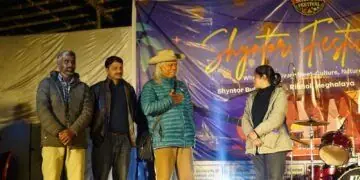
Shyntorbulia, Ri-Bhoi | A small, little-known village tucked away in the hills of Meghalaya's Ri-Bhoi district captured international attention after hosting the inaugural Shyntor Festival, an eco-cultural celebration that brought together visitors, artists and performers from across India and abroad.
Accessible only after a walk through rugged terrain and surrounded by the Umsha and Umsiang rivers, Shyntorbulia transformed into a vibrant cultural destination as the festival celebrated Khasi traditions alongside contemporary music, art and community-driven tourism. The event attracted participants from countries including Austria, Nepal and the United States, while visitors also travelled from several Indian states to experience the unique rural festival.
Organised by Rongjeng Welfare Foundation (RWF) in partnership with the Dorbar Shnong Shyntorbulia and local residents, the festival was conceived as more than a cultural event. It aimed to demonstrate how responsible tourism can generate sustainable livelihoods while preserving indigenous heritage and protecting the natural environment.
Over three days, visitors experienced traditional Khasi music and dance, live performances by artists from across the Northeast, storytelling sessions, handloom and bamboo craft demonstrations, local cuisine, riverside nature walks and community interactions. An art residency featuring artists from different parts of India added another dimension to the festival, turning the remote village into a creative hub.
The festival also provided direct economic opportunities for villagers. Local families managed accommodation in eco-friendly tents and bamboo huts, operated food stalls featuring traditional Khasi cuisine, and showcased handicrafts and agricultural products, ensuring that tourism revenue flowed directly into the community.
For the nearly 450 residents of Shyntorbulia, a village that remains isolated during the monsoon due to the absence of a permanent bridge, the festival represented a significant milestone. Beyond promoting tourism, it highlighted the development challenges faced by remote rural communities while demonstrating their potential to become sustainable tourism destinations.
According to the organisers, the festival follows a non-profit model, with proceeds earmarked for village development, infrastructure improvement, education and livelihood initiatives. The long-term vision is to establish Shyntorbulia as a model for community-led eco-tourism in Northeast India, where cultural preservation and economic development go hand in hand.